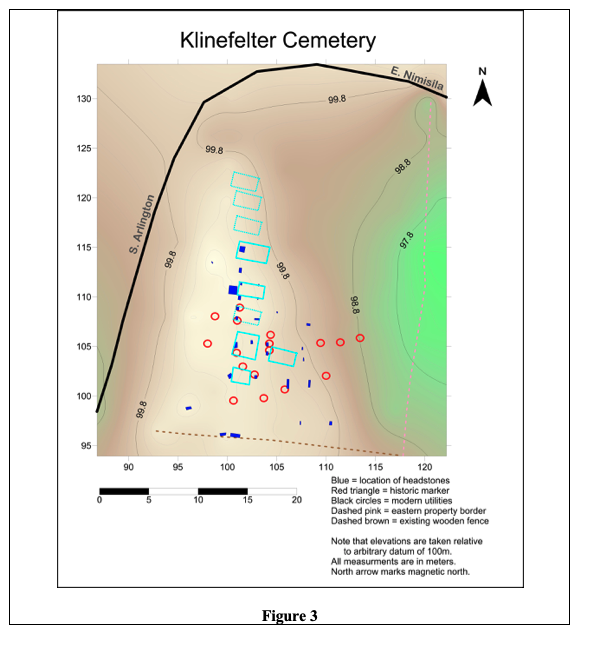
The Klinefelter Cemetery is located at the corners of S. Arlington and E. Nimisila Roads in Green Township, Summit County, Ohio. Dr. Tim Matney was approached by Sarah Haring, Community Development Administrator of the City of Green, at the request of Green Mayor Gerard Neugebauer’s Office in the fall of 2016. The Mayor was interested in delineating the boundaries in Klinefelter Cemetery. In particular, he wanted to install a fence around the historic cemetery but was concerned that many of the headstones in the cemetery had been damaged or removed. At the time, it was difficult to determine the extent of the burials and, subsequently, an appropriate location for the fence.
Shallow subsurface geophysical surveys were conducted at the Klinefelter Cemetery on two occasions. The first project took place in April of 2017 and the second project took place in May of 2018. During these investigations, a large portion of the cemetery was surveyed using magnetic gradiometry and electrical resistivity. Two techniques were employed: magnetic field gradiometry and electrical resistance.
Klinefelter Cemetery is approximately 30 by 25 meters in size. A total of 17 graves were confidently identified within the survey area from the geophysical survey results; more than 15 possible graves were identified for a potential total of over 30 graves. In addition to geophysical survey techniques, Dr. Jerrad Lancaster captured aerial drone photography of the survey area.
Figure 1 shows the overlapping results of the surveys conducted by our team and the students at Green High School. In total, SHiP identified 38 possible graves in Kleinfelter Cemetery using at least one survey method. In some cases (n = 5, 12.8%), especially in the Klinefelter graves, there is a correspondence between the visible headstones, the magnetic field gradiometry survey, and the electrical resistance survey. In other cases, there is correspondence between only two of the data sets (n = 9, 23.1%). The majority of the graves are only seen using one method (n = 25, 64.1%).
Full report will be uploaded to the Digital Archaeological Record (tDAR) in 2026.